pseudo-selectors

by

Reading Time: 3 minutesSo the :nth-child structural pseudo class is mighty handy already since it lets you select based on mathematical rules. But to my surprise, it got handier and no one told me. Which makes me think no one told you, either: :nth-child() can do filtering now!
by

Reading Time: 24 minutesThis is a blog post I’ve been meaning to write for like two years but haven’t, because it is a complex topic that’s a kind of modern-day Ouroboros where you don’t really know where to start but at no point do you think, “Everything’s fine; nothing could go wrong.” This is about how a feature

by

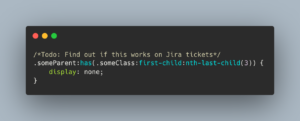
Screenshot of CSS with some snark

Reading Time: 3 minutesCSS continues to offer new ways to select things in ways we never could’ve imagined in the past (especially for an old timer like me). Today I want to focus on a possible (but not always probable) use-case: I have exactly n elements in a container. How can I do something only when all elements

by

Reading Time: 4 minutesCSS3 offers a ton of brand new ways that you can select elements in ways we’ve never thought of before. Today I want to focus on exclusively the structural pseudo-classes, which are ways of selecting elements based on the document tree. CSS2.1 limited us to :first-child and IE7 and 8 have done a great job since

by

Reading Time: 3 minutesIn an interview with Jacob Gube from Six Revisions on the subject of exciting developments in CSS3, Eric Meyer said  …the power to describe Web 2.0 designs in CSS is insignificant compared with the power to select every third table row starting with the fifth one.  Or being able to select the first paragraph within

by

Reading Time: 2 minutesSo in a follow-up to my post on layering the feedback with CSS, I’ve created a simple starting point with styling our forms: a form feedback boiler plate.