Pronoun is a spicy word these days and let me tell ya: I love spicy food. I figuratively and literally enjoy a delightful sting when I’m partaking in some sort of nourishment. There’s a lot of talk about pronouns but I want to talk through them: What they are, their linguistic function, and how they change and get changed by cultures.
There’s pronouns, and then there’s “preferred pronouns“
Before we dive into the languagey goodness, I want to call out that North American culture (mostly US) seems to be developing two senses of meaning for this word “pronoun”
- Pronoun, meaning a word that’s a member of a part of speech, which is a placeholder for a noun
- Pronoun, formerly called preferred pronoun, which relates to a person’s gender identity
If you are involved in social media discussions around pronouns, people inevitably conflate these two meanings because people crave spice. They may only be a ground-pepper-on-eggs person in real life but online they’re a sriracha-on-ghost-pepper person. Which means it’s fun to jump into a, “what’s the deal with pronouns” discussion by acting like they failed 8th grade English.
I will be talking mostly about the first meaning, which is the language-ish, linguisticy one. You will know when I am not, because I will tell you.
Grammar vs. Linguistics
This isn’t grammar class and this isn’t an article about “English grammar”. The grammar we learn in school is what linguists call prescriptive linguistics; speakers and writers of the language are being told how to use the language.
This is an article about language. When we get curious and observe how it’s used, it’s called descriptive linguistics; speakers and writers of the language are observed languaging.
So put your curious hat on and put the dictionary away.
What is a Pronoun
You may have learned in some grammar class for your native language these facts about pronouns:
- A pronoun is a word that takes the place of a noun
- A pronoun is a member of a small list of reserved words
Those are great facts for a grammar class, not for a linguist.
There’s a few reasons why linguists get all sweaty and itchy if you ask them what a pronoun is:
- Not all languages even have pronouns
- In the languages that have “pronouns”, it may not even be a “word”
- Languages are not all equally clear what their “words” are
- Many languages allow “words” to change parts of speech
- Not every language makes it clear when a word’s part of speech has changed
- Not all languages even have the same parts of speech
So how might a linguist define a pronoun?
A “pronoun” is usually a “word” that takes the place of a “noun” in a “language”, if any of those things exist.
A very twitchy graduate student
A Pronoun is what it Does
We’re gonna start off easy here and look at English, where the eight parts of speech are somewhat-ish identifiable-ish.
And we aren’t going to use a dictionary to define a pronoun. We’re going to identify a pronoun by way of its function in a discourse (some collection of sentences).
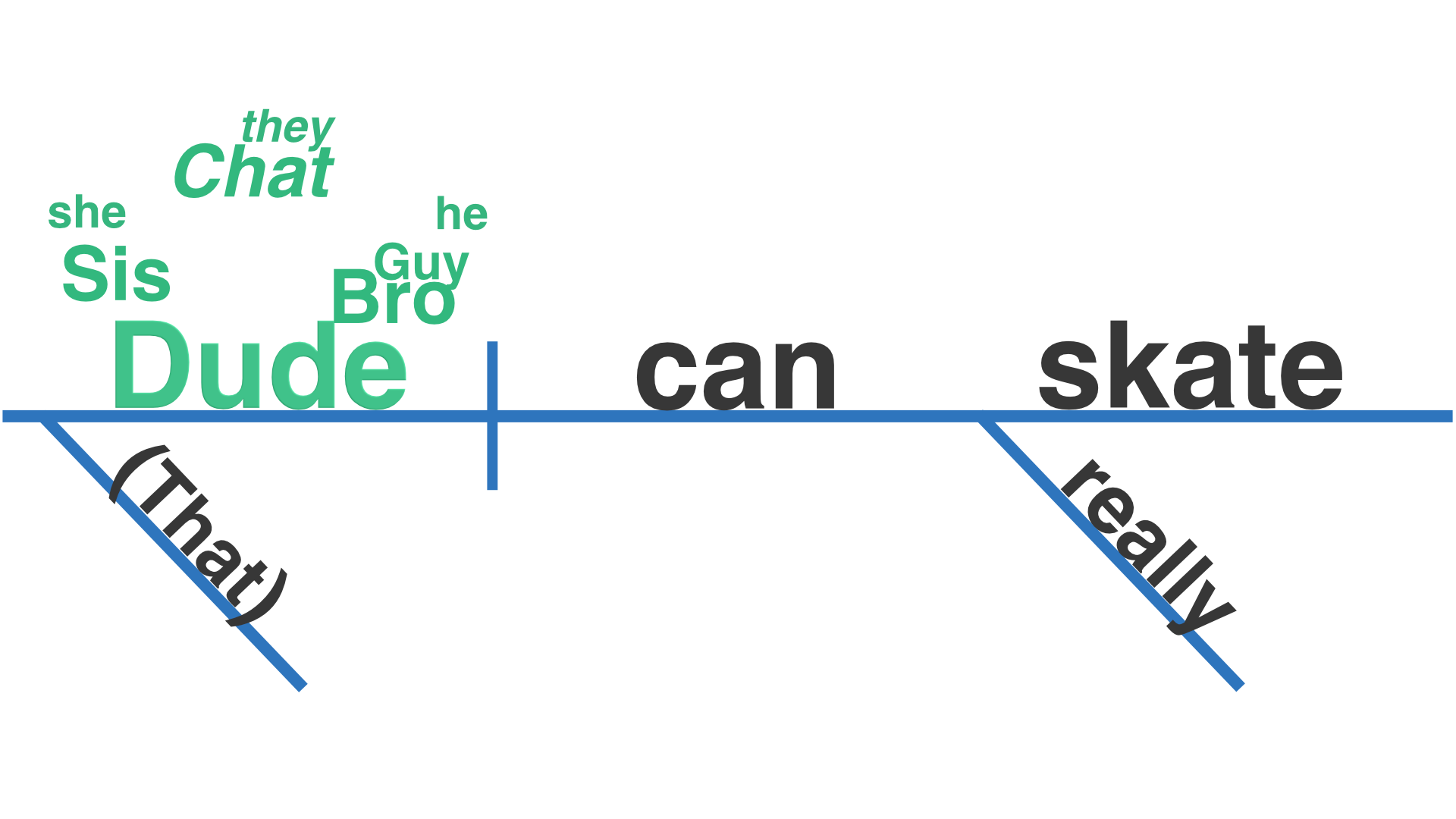
Tony Hawk can do a 900. Dude can really skate.
In this sentence, Dude is a pronoun.
Here’s why:
- Tony Hawk is mentioned in first clause but not the second one
- The next clause has a verb phrase can really skate
- In English, we cannot assume the subject for verbs like can or skate
- Dude does not have any determiners (a kind of modifier/adjective) like this, the, or that,
- We modify nouns, not pronouns1
So, when we evaluate words for their functions, Dude is a pronoun. It is acting as a third-person singular pronoun by taking the place of “Tony Hawk”.
And now here’s a case where dude is not a pronoun:
Rodney Mullen can kickflip. That dude can really skate.
- Rodney Mullen mentioned in the first clause but not the second one
- The next clause has a verb phrase can really skate
- In English, we still can’t assume subjects for verbs
- That is a word that functions as either a determiner, demonstrative pronoun, or relative pronoun, or for introducing verb phrases, but which is it?
- For that to introduce a verb phrase, it would be in a single sentence connecting verbs (e.g.
I can’t believe that I saw Rodney)
- For that to be a relative pronoun, it would have to introduce a relative clause, which it doesn’t (e.g.
I saw Rodney kickflip the picnic table that was in the street
) - For that to be a demonstrative pronoun, it would need to refer to a whole clause (e.g.
I saw rodney kickflip. That was awesome
) - For that to be a determiner, it just needs to be followed by a noun (e.g.
That dude can really skate
)
- For that to introduce a verb phrase, it would be in a single sentence connecting verbs (e.g.
We don’t say, “that he” or “this she” because determiners are these little ambiguity resolvers; they help clarify which one: this one, that one, these ones, those ones.
The fact that that is present, but its function isn’t one of introducing a phrase or being a relative or demonstrative pronoun leaves us with accepting its function as a determiner. And if it is determining something, the thing being determined is a noun.
The reason the thing determined is a noun is because a pronoun is already-determined. It doesn’t need help in resolving ambiguity.
So in the phrase, That dude can really skate
, dude is a noun. But if we say dude can really skate
, it’s a pronoun.
If you have to clarify the dude, the dude is a noun.
Bro, Sis, and sometimes Guy can also be Pronouns
It’s all about function. And we can identify if the word is functioning as a pronoun with three questions:
- Does it take the place of a pre-determined noun (i.e. a referent)?
- Does it not have any modifiers?
- Can the clauses be reasonably understood if you switch the referent noun with the pronoun?
They’re easy to spot as 2nd person pronouns
Todd, I need you to quit talking about IPAs. I’m tired of it, bro
Bro, I need you to quit talking about IPAs. I’m tired of it, Todd
Take note that Bro and Todd are interchangeable with each other. They are not interchangeable with you. If we were to place you in the position of bro the meaning of the first clause would change. If we switched it with Todd, it would be ungrammatical.
This is because Bro is acting as a vocative pronoun; a pronoun that’s used specifically to mark a person that’s being addressed.2
Vocative pronouns are these pronouns that go beyond offering ambiguity resolution and instead act as amplifiers. As if to say, “in case we’re not being clear, I want Todd and only Todd to STFU about his bitter-ass beer.”
Other languages denote vocative pronouns with an ending on a word (a case). English just drops ’em at the start or ends of clauses.
So “Dude” as a 2nd person pronoun is both a vocative pronoun and gender neutral.
They’re maybe a bit rarer as third-person pronouns, but it happens
It is admittedly more unusual that we’d see something like this:
Charlotte’s got some terrible hair today. Sis needs some help
Sis has some terrible hair today. Charlotte needs some help
But, it just goes back to function:
- Sis takes the place of some pre-determined noun
- Sis doesn’t take modifiers
- And we can switch the pronoun and the referent noun without changing meaning or losing understanding
“Bro”, “Sis”, and “Dude” can be third-person pronouns, but they’re hardly gender-neutral.
Does this mean that in AAVE…
Yes. It absolutely does. The n-word in African American Vernacular English also sometimes gets used as a pronoun.3
If you are a native speaker of that dialect, you have a pronoun just for you. That’s pretty cool.
And on the topic of dialects and pronouns…
They Asses, Damn-selves, Fuckers, and Wankers
John McWhorter wrote about this in, “Talking back, Talking Black,” and he even produced a chart.4
| Object Pronoun | Emphatic | Dismissive subject / object | Emphatic Dismissive |
|---|---|---|---|
| me | myself | my ass | my damn self |
| you | yourself | your ass | your damn self |
| him | himself | his ass | his damn self |
| her | herself | her ass | her damn self |
| us | ourselves | our asses | our damn selves |
| y’all | yourselves | y’all asses | y’all damn selves |
| them | themselves | they asses | they damn selves |
We don’t just classify pronouns as subjects and objects and indirect objects.
They aren’t just vocative, either.
They can also be dismissive or emphatic dismissive.
In AAVE, his ass is not “determiner + noun” in the way that that dude is, because that dude is not communicating new semantic information that arrives only at the combination of those two words. His ass uniquely communicates not just dismissiveness but a degree of it.
Her own damn self is a whole-ass phrase that’s a pronoun because all four of those words exist to refer to a person who is two-degrees of dismissed relative to the speaker.
So in AAVE, you have 2-word or 4-word combinations that act as pronouns.
The rest of us gotta use tone
We have an equivalent in other dialects of English via the words “wanker” and “fucker”. In fact we could take either of those and test them with our skateboarding examples:
Phony Flock can’t do a 180. Fucker really can’t skate.
Shmodney Fullin can’t ollie. Wanker really can’t skate
What’s interesting here is that, if you know anything about skateboarding, you might agree that this is a high degree of dismissiveness for the discourse. Pragmatically, it suggests I have beef with Phony and Shmodney that’s unrelated to their skill.
I would probably rely on tone to indicate the dismissiveness on one of our other neo-pronouns, instead:
Phony Flock can’t do a 180. Bro really can’t skate.
Shmodney Fullin can’t ollie. Dude really can’t skate
If and whether bro, dude, wanker, and guy are capable of communicating dismissiveness through tone is totally going to depend on dialect, sociolect (language features within a dialect) and idiolect (how I personally speak).
So it’s very cool that AAVE can communicate degree dismissiveness so efficiently with these new pronouns.
And on the subject of neo-pronouns...
New Pronouns Pop Up Periodically
In English, the 2nd person singular pronoun you is somewhat newish.
In Early Modern English, thou was a singular informal nominative pronoun and thee was a singular informal oblique informal pronoun.
You was a singular formal pronoun.
English got tired of having formal and informal pronouns, and decided to use you everywhere.
Spanish had one pop up a while back, too
You probably learned this pronoun chart in Spanish and found yourself quite perplexed as to why “Formal You” and “Formal Y’all” were considered third person.
| Singular | Plural | |
|---|---|---|
| 1st | Yo (I) |
Nosotros (We) nosotras |
| 2nd | Tu (You) |
Vuestros (Y’all)
Vuestras |
| 3rd |
El (He) Ella (her) Usted (Formal you) |
Ellos (Them) Ellas Ustedes (Formal Y’all) |
What your Spanish teacher may not have told you is why Formal You is a third-person pronoun.
That’s because it was originally vuestra merced, which meant, “your lord / your mercy”.
That might sound strange but if you’ve ever been in court and addressed a judge, you’ve said, “Your honor.”
Spanish eventually got tired of saying two words when one would do, so they mashed them together until the consonants fell off and we ended up with usted. 5 Old timers like me still remember seeing usted abbreviated as vd well into the 90’s. This was why; it was a collection of words that evolved into a pronoun.
So English has dropped pronouns, Spanish has put some in the “wrong” spot. Languages be wildin’
French got a new pronoun just a few years ago
Le Robert, fairly respected French dictionary, added “iel” in recent years. Iel is a third-person singular neuter pronoun.
Dictionaries don’t add stuff because they’re telling us what to do. They add stuff because they’re telling us what people are doing.
People were using iel the same way we might use the “singular they”: to refer to a person when their gender isn’t known or part of the binary.
Turns out, that was fairly easy to do in French, despite the fact that it has this thing called “Grammatical Gender”. It mostly amounts to the fact that in spoken French, you don’t really hear grammatical gender much, so it was no big deal.
Wait, what’s Grammatical Gender?
The tl;dr is that it’s a thing that indicates gender through the grammar of the language.
Before we dive into that, we need to back up.
English is a weird language
If you look at all the languages spoken in Europe, the Middle East, and the Indian subcontinent (which make up a giant-ass language family called Proto-Indo-European), they all have this feature called “grammatical gender.”
English doesn’t. It has gendered pronouns, but no grammatical gender.
We’re the only one. In the whole-ass family.
So what do those other languages have?
All of these other languages in this family have pronouns that mean “he” or “she” or “y’all informal men” or “y’all formal ladies.”
But then they have nouns that are either “male” or “female” or sometimes “neuter”. Spanish has a masculine sun and a feminine moon. Portuguese has masculine love and feminine ideas. German has neuter relics and votes, masculine summer and Monday, and feminine oaks and roses.
But that ain’t all. Then you have to modify your adjectives so they match with the nouns.
In Spanish you can’t say “la taza es rojo” (the girl-cup is boy-red). You have to say, “la taza es roja” (the girl-cup is girl-red).
This is Grammatical Gender. It’s “grammar” in that it’s a set of rules for how you use words together. It’s gender in the sense that gender means category.
Grammatical Gender is a bunch of category agreement rules
If you’re wondering how the hell this happened, the answer is simple: “we don’t know”
We actually see in most dialects of Chinese that words are marked not for anything like gender, but more like shape. When you count stuff in Chinese, you might need to indicate if you’re measuring long and skinny stuff, flat things, small animals, things with handles, etc. Some linguists theorize this is the birth of grammatical gender. 6
There are some theories that at some point in the very distant past we needed to communicate categories of things, and somehow it just kinda started to align kinda-sorta-maybe with biological sex sometimes.
You will find patterns in all the PIE languages. In some languages, ideas and concepts are more likely to be feminine. In some languages, animals may skew masculine.
Regardless, it’s fairly arbitrary and it’s best to not think about it tying really closely to sex. We’re best to think of it as category.
Worth remembering is that the etymology of the word gender connects it to the words genre, gene, and genealogy.7 Gender always meant some sort of “category”, and Grammatical Gender is absolutely no different; it’s “categorization grammar”.
English is weird, part 2
So we’ve established that PIE languages have grammatical gender. And that grammatical gender is just “categorization grammar”. And since everything fits into 2-3 ish categories, that means the pronouns need to as well.
Old English had grammatical gender, and therefore it had the gendered pronouns, and the world made sense.
But as English speakers got themselves repeatedly colonized by Vikings and French and adults were learning this strange smashup of rules, they stopped caring about the grammatical stuff and just held on to the he/she pronouns.
And that’s weird because English doesn’t need gendered pronouns! We don’t need to align our adjectives or our verbs to it.
English is much more like the other 60% of the world’s languages which don’t have grammatical gender at all. 8
Whether you’re speaking Mandarin, Turkish, Navajo or Cherokee, you don’t have a word that means he or she or it. They all use one “word” that just means something more like “he/she/it/whatever it’s not you or me or us”.
Pronouns are Pointers—with Extra Info Encoded
The linguistic function of a pronoun, as we’ve established, is to point to some other noun that we know about by context. But the pronoun doesn’t just replace a noun. It also encodes some additional information.
We’ve already talked about some of the information that a pronoun encodes:
- Person
- Relation of referent to speaker. e.g. 1st, 2nd, 3rd.
- Gender
- Category/ type of noun. e.g. male, female, neuter
- Quantity
- The amount of referents. e.g. singular, plural,
- Address
- Recipient of message. e.g. vocative
- Formality
- Defference afforded to the referent. e.g. informal, formal
- Dismissiveness
- Displeasure with referrent. e.g. Dissmissive, emphatic dismissive
But in other languages a pronoun might transmit not just more information, but more kinds of information:
- Personhood
- Whether the referent has sentience. e.g. Object or Person (i.e. he/she or it)
- Animacy
- Whether referent is alive. e.g living, not-living
- Quantity or Number
- Precise or imprecise amount of referents. e.g. singular, dual (exactly two), trial, plural
- Clusivity
- Whether a referrent is part of, or removed from, a group. e.g. inclusive, exclusive
Now, why some languages have pronouns that identify living versus dead or not-you and not-person can be a mystery.
But a reasonable guess is that it has to do with the environment and culture. It seems like languages that have clusive pronouns tend to be in family-based cultures9. Languages with animacy pronouns seem to be in cultures that depended on hunting.
And by the way, this is where it gets hard to even decide if something like animacy is even a category separate from gender. It is a “category” after all!
Language and Culture Affect Each Other
We’ve already established how colonization (read: invasions) forced English to give up on grammatical gender. Our relationship with nobility might have affected our desire to nix formality, too. Or maybe it was just a mouthful of th- to spit out those thees and thous.
Regardless of the underlying reason, language affects how we talk about the environment, and sometimes the environment requires us to come up with novel ways to communicate about it.
In English even 30 years ago we were teaching kids to use “he” as a gender neutral pronoun when talking about unidentified people, à la, “An astronaut puts on the suit if he wants to live.”
This felt clunky then because in private speech we were already using a singular they, which we’ve been doing for hundreds of years. 10 In recent years we’ve shifted towards singular they because it feels more inclusive.
It’d be nice if English had a neuter third-person singular pronoun that communicated personhood, but it doesn’t, so here we are.
And then the “Preferred Pronouns” 11
Let’s remind ourselves the function of a pronoun:
It’s a pointer to a noun, with extra information encoded sometimes.
If a person shares their pronouns, what they are doing is giving you words that serve as a pointer to themselves. They are explicitly sharing “how to communicate” info you wouldn’t otherwise have. That info may have extra info encoded.
It helps in cross-cultural communication
Many of the languages with grammatical gender also have names that follow the conventions of gender (e.g. Carlos / Carla, Paulo / Paula, Mario / Maria). Within a gendered language, it can be easy to identify the gender of a person and know which grammatical rules to follow. Even if the name doesn’t give it away, their use of adjectives and possibly verbs will. 12
I can tell you that because of my prolonged exposure to Spanish and Portuguese, I naturally assume a name ending in -a is for a woman. This is problematic because my Indian co-workers’ names don’t follow that pattern! (So sorry, Suriya).
And this of course goes in the other direction, too. It can be hard to know from looking at an English speaker’s name which pronoun to use especially if you’re coming from a language that doesn’t even have gendered pronouns (a common conundrum for our Turkish and Chinese speaking friends).
It also helps in just being helpful
Even if it’s English-speaker to English-speaker, it’s helpful. It’s only weird to share pronouns in the same sense that it’s weird that English has gendered pronouns.
When a person is sharing their pronouns, they’re saying, “this is how you can point to me in your language.” They’re providing a piece of information that you can use to be a more efficient communicator. And that piece of information might have some arbitrary piece of category information encoded with it.
So whether the pronouns are he/him, they, dude, bro, or “kiss my ass”, all someone is telling you is, “this is how to point to me, and this is my category.”
Pronoun away, dudes (and dudettes)
Dude can be a pronoun. So can sis, bro, guy, and just about any other word that you can use to take the place of a noun or noun phrase. Pronouns are pronouns because of what they do, not where they are in a dictionary.
Some will try to argue that dude is a gender-neutral pronoun — but that can only be true in the vocative. I’m very sorry to all the moms and grandmas hearing your Gen-Z kids calling you “dude” and “bro”. To you, it sounds like they’re misgendering you. But to the speaker, these pronouns are gender neutral 2nd person vocatives.
If you’re a female-identifying Boomer or Gen-Xer who dislikes being called “dude” or “bro”, just say “chat, we’re not putting up with an NPC showing main-character energy right now”. And don’t forget to take your Advil.
No one hears, “Dude knows how to skate,” or “dude and I went on a date” and thinks, “obviously you mean a woman.” 13 But my wife has called out my teenager daughter’s BS more than once by saying, “dude, no.”
A pronoun is merely a pointer to a noun with optional extra info encoded. Have your damned selves a good time using ‘em, y’all.
Sources and whatnots
Footnotes
- Carol Genetti makes it very clear in “How Languages Work” in her chapter on word classes that one of the distinctions between noun and pronoun is,
Nouns can co-occur with modifiers while pronouns cannot
. - You can also recognize vocatives by the Vocative Comma. This in fact is critical sometimes in clarifying whether the addressee is an object.
This is a fascinating detour into what kinds of pronouns “Dude, Bro, and Sis” can be because while they can be 2nd person vocative pronouns, they cannot be third person object pronouns. We sayI don’t know, bro
(2nd person) but we don’t sayI don’t know bro
(third person).
Isn’t linguistics fun? - African American Vernacular English (sometimes called Black English or Ebonics) is a well-studied dialect in the US. Folks may not be aware this dialect has been studied for 50 years, but it has.
In AAVE, there are two “n-words”, one ends in an -a and the other ends with -er. They are pronounced differently and mean very different things.
The -er form is a slur. It is a slur in all dialects of English. Grammatically speaking, it’s a noun.
The -a form can be a first-person pronoun when preceded by the word a, it can be a second-person vocative, or it can be a third person honorific if someone saysThis/that/my n-word
.
So it is the -a form of the n-word that’s a pronoun, because that form only exists in AAVE. See my citation, “Semantic Bleaching and the Emergence of New Pronouns in AAVE” for details. - You can read about some of the grammatical complexities of AAVE in Chapter 1″It’s Complicated”. The Ass chart is on page 49. It’s based on original research by Chris Collins, Paul Postal, and Simanique Mooday that’s an absolutely delightful 56 page read that’s mostly about ass.
vuestra merced
=>vuesarced
=>vusarced
=>vusted
=>usted
. It literally was a case of the consonants getting softened until they just weren’t pronounced.- John McWhorter has a delightful Lexicon Valley episode where he goes into fun detail about the theories of the origins of grammatical gender
- We can trace the word “Gender” all the way back to the Latin word “genus” and see how it came to mean “genre” in French. That lovely word “genus” is also the originator of the word “general” which means “all of the parts in that class”.
Gender and Sex were used somewhat interchangeably for about 500 years. In the 20th century, “sex” started to mean sexual intercourse, and then gender started to mean “social construct”. As recently as 60 years ago, “gender” was used to mean grammatical gender - You can view a map of gender distinctions in pronouns and see that really it’s Africa and Europe for the most part that make this distinction.
The more accurate measurement is that 57% of languages don’t have gendered pronouns.It is worth noting that this may not perfectly align with a concept of grammatical gender. - Dolakha Newar, spoken in Nepal, and Bardi in Western Australia, are two examples of languages with inclusive and exclusive pronouns.
- You can trace “singular they” all the way back to 1375 in this lovely medieval romance called, “William and the Werewolf.” Singular they didn’t become a problem with grammarians until the 18th century because why come up with a solution when you can be the problem?
- The LGBTQIA Resource Center for UC Davis recommends avoiding using the phrase “preferred pronouns”. The reasoning (which makes sense) is that it suggests identity is flexible or less than valid.
Regardless of your views on the subject of gender identity, it would make sense to not label them as “preferred” because it’s a part of speech that communicates grammatical usage. We don’t say we have preferred adjectives, prepositions, or verb conjugations (if we do, I prefer my verbs only be expressed in the subjunctive because I’m very non-commital). - There’s at least one Italian dialect that require verbs to reflect gender.
But then there’s the Afro-Asiatic (Semitic) languages like Arabic and Hebrew that *always* require you to conjugate a verb for gender. Some dialects of Arabic have gendered first-person pronouns, too!
You can hear the conjugation in even first-person singular verbs for Hebrew. There will be an “I (a female) read”, and “I (a male) read”. -
This is the one statement for which I don’t think I can provide hard, empirical evidence. It requires probably a combination of field research and/or textual analysis (i.e. reading a bunch of social media posts). However…
I have very basic test that I perform which requires forming a discourse that meets these three criteria:- It contains the word dude
- There is another actor with an androgynous name doing something with the dude
- The action that is performed doesn’t immediately suggested gender of either actors
Terry went on a date with that dude last night
Blake is getting really fed up with dudes right now
Pat loves dude’s shirt
Say / write these out, and ask someone the gender of dude, and then the other person. Dude is gonna be a dude. Sorry, bro.
Citations and Further Reading
- Genetti, Carol. (2019). How Languages Work. (2nd Ed).
- Jones, T. W., & Hall, C. S. (2015). Semantic bleaching and the emergence of new pronouns in aave. LSA Annual Meeting Extended Abstracts. https://doi.org/10.3765/exabs.v0i0.2994
- Why is Usted sometimes abbreviated. (2019, August 14). ThoughtCo. Retrieved September 3, 2024, from https://www.thoughtco.com/why-is-usted-sometimes-abbreviated-vd-3079197
- Aston, William George. (1904). A Grammar of the Japanese written Language. (3rd Ed)
- McWhorter, John. (2017). Talking Back, Talking Black. Bellevue Literary Press.
- Parrott, Lilli (2010). Vocatives and Other Direct Address Forms: A Contrastive Study. Vol 2, No 1. Oslo Studies in Language
- Bob de Jonge. (2005). El desarollo de las variantes de vuestra merced a usted. Vol 22. Estudios de lingüistica del Español.
- «Iel» dans le Robert : «un coup de pub» pour Hélène Carrère d’Encausse, de l’Académie française. (2022, February 23). Le Parisien. Retrieved September 4, 2024, from https://www.leparisien.fr/societe/iel-dans-le-robert-un-coup-de-pub-pour-helene-carrere-dencausse-de-lacademie-francaise-23-02-2022-OXEAWZUBVFCRFKG3KED4SHSSI4.php
- Mcwhorter, John (Host). (2020-present). Lexicon Valley. Slate. https://slate.com/podcasts/lexicon-valley/2021/01/language-gender-noun-classes
Special thanks to Kev Dooley for their help in proof-reading this article
Permalink
I suspect that speakers of North Indian languages find Spanish grammatical endings just as confusing. In many North Indian languages male gender is indicated with an ‘a’ ending and female with ‘i’.
However it’s quite common not to follow grammatical gender in personal names, so you can find males called Saraswati and females called Ganga.
Permalink
The uses of “wanker” and “fucker” you discuss above are distinct from the pronominal uses of “bro.” The former two are instances of Left-Edge Ellipsis. This is a phenomenon whereby an unstressed element whose semantic import can be deduced from context is elided in informal speech. Crucially, this can only take place at the very left-edge (hence the name) of the sentence. English likes to do this a lot, and I’m pretty sure “wanker” and “fucker” are instances of an elided definite article or something else with demonstrative force.
The parentheses indicate that a word can be dropped. In the case of (iii), “have you” can be elided altogether, or just “have” can be elided. Elision of “you” without “have” produces ungrammaticality: *have seen the new star wars movie yet?
(1) I went to the store yesterday. (I) had some trouble finding the eggs.
(2) I hate Bill. (that) guy’s always foolin’ around.
(3) ((Have) you) seen the new Star Wars movie yet?
Likewise, eliding “have you seen” is grammatical because the verb is intimately involved in the meaning of the wider sentence and its elision constitutes too great a disruption in meaning. Its contribution to the sentence is not simple enough to just be assumed.
Instead of “wanker” and “fucker,” let’s use the word “guy.”
(4) that guy is tall (no elision)
(5) guy is tall (left-edge ellipsis)
Now put in someplace that isn’t the phonological left edge:
(6) We should invite that guy (no elision)
(7) *We should invite guy (left-edge ellipsis)
In such a position, left-edge ellipsis produces ungrammaticality.
I believe that “wanker,” “fucker,” and “guy” — normal nouns — are different from this innovative use of “bro”:
(8) bro has no idea what he’s doing
(9) I saw bro at the party last night
(10) Is that bro?
This use of “bro” is not available to all speakers. I am Gen-Z and can access it easily, but to my professors it is exceedingly odd.
Another interesting effect of bro is that it can take a referent of any gender:
(11) Bro’s lost his/her/their marbles
This runs contrary to the word’s original, exclusively male meaning. (Note: although there is no ~pronominal~ use of the word dude, it can also be used to address or refer to feminine individuals in spite of its traditional meaning; see Kiesling’s (2004) paper on “dude.”)
“Bro” also cannot be pluralized:
(12) bro is goofy (intended: he/she is goofy, they(sg.) is goofy)
(13) *bros are goofy (intended: they(pl.) are goofy)
“Wanker” and “fucker” can be readily pluralized:
(14) I hate those guys.(those/the/them) wankers/fuckers are mean bastards.
Permalink
I appreciate this article. I am a 46 year old Genderqueer person and “Dude” is my LITERAL preferred pronoun. I AM from California and we do use it regularly here and to me it has always been non gendered. I get really frustrated when I see all these articles that it is a “joke” to use dude. To me it is the most comfortable, not having gender expectations at all, way to be referred to. I feel SO MUCH BETTER if people use “dude”. Every single preferred pronoun has been the butt of jokes, and that doesn’t make the rest of them less serious or off limits. I wish people would back off and allow others our own freedom of self expression and not put boxes around things.
Permalink
thanks for saying that, Fox!
For one I’m happy it’s a comfortable identifier. For another, that’s really exciting from a linguistics perspective that it’s transitioned into the non-binary sense.
I’m currently conducting some ongoing research into the use of these “social pronouns” and once I’ve compiled enough data, I’ll publish a follow up post. Not only does dude lean much more gender neutral, it appears that “bruh” and “bro” are losing some of their sense of gender, too. At least in certain situations.
Permalink
I really enjoyed reading this. Thank you for writing it.